This morning at the (impossible to find) Wind River offices on Scranton, Marco Thompson hosted the “Android VIP Roundtable III” with four expert panelists on the Google-sponsored open source platform.
As part of hosting the event, Russ Christensen of Wind River put in a plug for the company’s hardware and software design activities for mobile — including Android-based devices. It struck me how much Dr. D has helped transform Wind River.
Once upon a time, Wind River was an embedded tools and OS (VxWorks ) licensing company that aspired to be the Microsoft of the embedded world. They spent a lot of time predicting such an outcome — I remember one Embedded Systems Conference where the pitch was particularly strong — but the industry for years remained badly fragmented.
Now the industry is consolidating around a common platform, but it’s not VxWorks. Instead, it’s Linux, which has many other suppliers beyond Wind River. And the common toolset for the embedded world is based on Eclipse.
So with the proprietary licensing business shot, Wind River has found a new niche around being a solutions provider. The pitch today on Christensen’s slides emphasized time to market.
This was always the Dr. Design story. Founded in 1984 by Marco (UCSD ’79), their speciality was to solve seemingly impossible problems in an insanely short period of time (and charge accordingly).
In 1999, Wind River paid $400+ million to acquire solutions provider Integrated Systems, Inc. In 1996, ISI had paid about $17.5 millionto buy Dr. D.
So what once might have looked like a less-scalable, lower margin complementary business to Wind River’s platform sale has now become an integral part to their new business model based on integrated solutions that integrate an arbitrary combination of hardware and software, off-the-shelf and custom components. This is exactly what Dr. D did for 12 years before Marco cashed out.
The results are not exactly as dramatic as the NeXT takeover of Apple that ushered in the Jobs II era, but in this era of commoditized software platforms, it’s still a happy outcome as Wind River seems to have made the transition to fight another day.
Thursday, March 26, 2009


Wednesday, March 25, 2009
Cricket's big idea
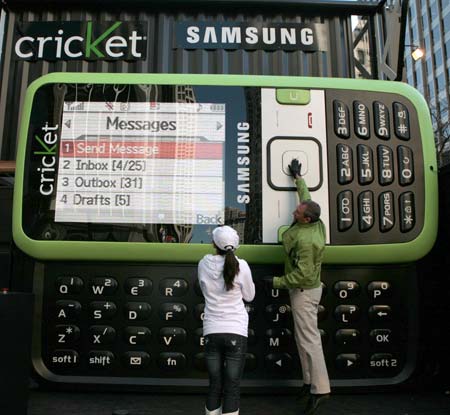 In Philadephia, Cricket and Samsung are unveiling a 13' high replica of the Samsung Messenger.
The two companies earlier showed the giant phone in Chicago, as part of a publicity stunt for Cricket’s entry into the local market.
San Diego’s Leap Wireless (which owns the Cricket brand) has expanded to 35 of the top 50 markets with a POP of about 84 million — or about 27.5% of the potential US market. At the end of 2008, it had about 3.8 million subscribers.
Its younger roaming partner/low cost rival/spurned suitor Metro PCS is covering both unique and overlapping markets, with coverage in 92 of the top 100 markets. It ended 2008 with about 5.4 million subscribers.
Together, the two carriers have about 3.5% of (my estimate of) the 265 million US cellphone subscribers at the end of 2008, far behind the 28% of #1 Verizon Wireless (plus Alltel) or even the 12.4% of the smallest of the surviving national carriers, T-Mobile.
Photo from Chicago taken from Techgadgets.in.
Tuesday, March 24, 2009
Nokia joins The Network
After largely giving up on CDMA in the Americas, on Monday Nokia introduced a stylish new flip phone, the Nokia Intrigue 7205.
The new phone is being offered exclusively on the largest US carrier, CDMA-based Verizon Wireless. It is the third CDMA phone here in the last year for Nokia, beginning with the 6205 and more recently the 2605.
It is unclear whether Nokia will have any impact on the LG and Samsung dominance of featurephone sales at Verizon stores across the country, but it is the logical next step after the patent settlement with Qualcomm.
Subscribe to:
Posts (Atom)
