Showing posts with label mobile phones. Show all posts

Tuesday, September 4, 2007

Cricket-eating MetroPCS

As rumored at the time of their April IPO, MetroPCS is today offering to buy San Diego-based Leap Wireless, operator of the Cricket mobile phone service.

Both are “all you can eat” CDMA carriers, and both are adding subscribers at far above the national rate (45% and Leap — a 1998 Qualcomm spinoff — got their first, but its growth was long stalled due to poor timing of buying expensive equipment (with expensive vendor financing) near the peak of the bubble, eventually resulting in recapitalization through bankruptcy. MetroPCS came along in 2002 and has had an uninterrupted run of success over the past five years.

With its concentration on major metro markets, MetroPCS is slightly bigger overall, while Leap has more licenses in more cities. Both have roaming problems — lacking the coverage of a Verizon or even a T-Mobile. But the Leap has partially addressed that by clustering nearby markets (like Albuquerque, Santa Fe, Las Cruces and El Paso or Phoenix-Tuscon), to solve the most likely roaming needs of a subset of customers.

The MetroPCS investor presentation shows the combined markets covered by the two firms, including a strong cluster of licenses in California. Together the two firms would have licenses (if not coverage) in nearly all of the top 25 and top 200 markets.


The two are obviously stronger together, and MetroPCS (ticker: PCS) is bigger than its prey, with a $10 billion market cap vs. $5.5 billion for Leap (ticker: PCS). Other than prior bad blood over alleged patent infringement, executive egos and layoffs at Leap’s San Diego headquarters, it seems like all that’s left is haggling over the price. Red Herring notes that investors bid prices above the offering price in anticipation of a better offer, despite the efforts by Metro’s CEO Robert Linquist to convince the market that the Leap stock price has included an acquisition premium since April.

The only thing that went beyond the normal range of hyperbole is that the merger creates “a fifth national wireless carrier.” As of June 2007, the combined companies would have barely been the sixth largest carrier in the US with 6.2 million subscribers, versus 12.2 million for Alltel and 6.0 million for U.S. Cellular. (Both CDMA carriers). So while MetroLeap might have more licenses, it would have rather thin penetration.

If they pull it off, the more important question may be: what’s the endgame? The one thing protecting MetroLeap from being squashed like a bug is that the big boys can only compete on price by cannibalizing existing revenues, something they are loathe to do. So who would be the next MetroLeap merger? Would either Alltel or U.S. Cellular be willing to shift to a flat-rate model to enable a nationwide attack on the big four? And since the national market has consolidated from six to four carriers (or perhaps 5½ to 3½), can the market really support another national carrier?

Technorati Tags: , , ,

Thursday, July 26, 2007

We’re #1! We’re #1!

Finally some good news for Qualcomm. As Information Week reports:
Its legal troubles notwithstanding, Qualcomm has supplanted Texas Instruments(TXN) as the world’s leading supplier of integrated circuits for mobile devices, according to data from market research firm iSuppli.

This reshuffling marks the end of, or at least a pause in, Texas Instruments' long reign at the top of the mobile semiconductor market. The first quarter of 2007, according to iSuppli senior analyst Francis Sideco, “marks the first time that TI has not occupied the leadership position in this area since iSuppli began tracking handset market share in 2004.”
iSuppli credits Qualcomm’s monopoly on EV-DO chips (where TI is not currently supplying product) as well as its W-CDMA chips. Of course, TI’s CDMA line traces back to its 2000 acquisition of San Diego-based Dot Wireless for nearly $500 million.

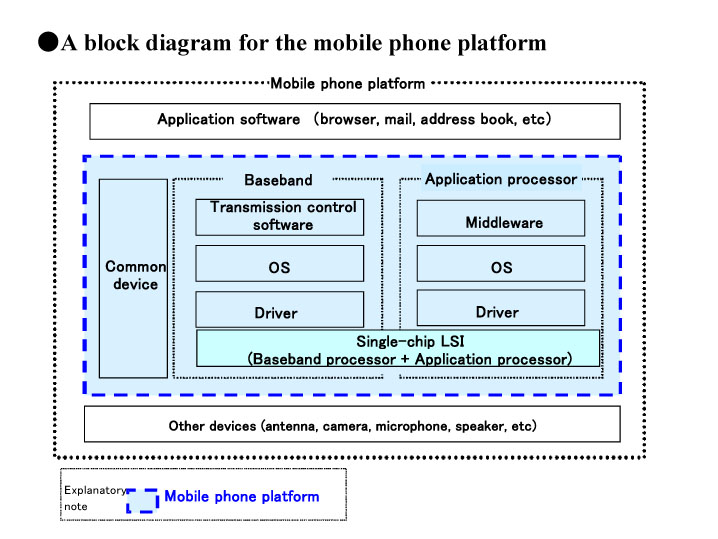
So this is certainly good news for TI. At some point I do need to figure out one discrepancy: everyone has been listing TI as tops in the mobile phone IC market. However, ARM-licensed microprocessors are in more than 80% of all mobile phones being sold (one figure has it above 95%), so who could have more market share than that? So yes, TI is a licensee of ARM and today some of its most popular products are the OMAP application processors containing both a C55x DSP and an ARM9 core.

TI’s own claims are:
  • today the company has the majority of market share in GSM/GPRS mobile devices.
  • Additionally, more than half of 3G WCDMA handsets use TI basebands, and
  • even more use OMAP applications processors.

There’s a double counting problem here: obviously one company could have a majority share for the baseband processor and another majority for the application processor (unless it’s a dual-core processor). There’s even a potential triple counting of share between an IP licensee like ARM, a fabless semiconductor company like Qualcomm and a foundry (like IBM or TSMC used by Qualcomm); it’s only double counting (ARM and TI) for TI which makes its own chips.

Graphic: courtesy Fujitsu.

Technorati Tags: , , ,

Friday, June 1, 2007

In praise of cheap wide pipes

This weekend I’m in Marina Del Rey (near LAX) at the annual conference of researchers who study the mobile communications industry.

The conference has a very international flair. One session I attended was about the (under) adoption of mobile TV in Korea and the UK. Another was a multi-country study on attitudes towards mobile data adoption.

Given the concerns of the industry for revenue growth, it’s not surprising that mobile data is a big topic here. Why aren’t more users using mobile data? What are the killer applications? What kind of content will create demand and make money? What is the relative mix of short content (e.g. 30 second clips) vs. long content (entire TV shows or movies)?

And what will be the pipes? Will they be the 3G cellular pipes? Or will they be one of the alternatives, such as personal Wi-Fi, business Wi-Fi, Wi-Fi hotspots, municipal Wi-Fi or WiMAX?

Both for transport and for content, there were many concerns about business models because winning business models for wireless data are few and far between. The one exception is that Japan’s DoCoMo (reportedly) collects a 9% charge for billing/invoicing all m-commerce transactions.

[LA GMR panel]Given the location, it was appropriate that the first plenary session focused on video entertainment. The panelists for the session entitled “Mobilizing Digital Hollywood” were:
  • Derek Broes, Senior VP Digital Entertainment, Paramount Pictures (ex-Microsoft)
  • Chris Brunner, VP Mobile Content and Services, Univision, Online — selling TV content
  • Neil McGinness, IMG — mainly selling sports content through deals with various sports leagues
  • Mark Young, Disney, VP Business Development and Strategy
  • Bill Sanders, Sony Pictures Television International, VP Mobile Networks Programming and Digital Product Development (formerly with HBO)
SMS is highly profitable with limited bandwidth, but a key issue for rich multimedia content is the characteristic of the pipe. Among the key issues:
  • The bandwidth for individual users. 3G is now offering a megabit/second, as does Wi-Fi, but fiber to the home is offering tens of mbps.
  • The efficiency of the bandwidth. In an earlier session, Dave Tilson’s paper on mobile TV noted that in one of the UK trials, cellular networks could only support 6 mobile TV users per cell. Sony’s Sanders said that carriers see mobile data like a health club membership: “They want you to pay your monthly fee but not show up too often”
  • Pricing. For single professionals and students, switching from a home-based broadband to a PCMCIA-based broadband (each at $30-$40/month) is realistic. But otherwise, Elizabeth Fife reported that for the US respondents of the Worldwide Mobile Data Service Study, the most popular answer was that users were willing to pay about $5-20/month for mobile data service.
So a lot of the interest is in moving traffic off the cellular network to other sources, such as municipal Wi-Fi or commercial WiMax service. Seamless switching between cellular and Wi-Fi/WiMax is a key concern of most firms in the mobile industry — except of course for the carriers.

Still, both 802.11/802.16 alternatives have problems. The hopes and claims of municipal Wi-Fi systems have not been proven, and most (if not all) are failing to hit their financial and adoption goals.

WiMax has been sponsored by Intel as a direct attempt to bypass Qualcomm and cellular carriers. However, the business models have not yet been proven. I wonder about the capacity — if each antenna only supports 60 concurrent connections, how many antennas do you need to build to cover a city? If you are building cells (with backhaul), how are the economics different than cell phones?

One way to increase capacity is to go Back to the Future: instead of unicast, go to a broadcast (“multicast”) model (i.e., the 1950s TV model). Usually this means moving the traffic off the network to new spectrum: terrestrial VHF or UHF (like MediaFLO) or direct satellite broadcast (as in Korea’s S-DMB). For something like live broadcast of the World Cup, it’s hard to imagine another solution that will offer the economic or spectral efficiency. One of the Hollywood panelists (didn’t see who) specifically praised MediaFLO and its economic efficiency as potentially changing the whole mobile content industry.

There is one other example of mobile video — in its infancy — being like TV of 60 years ago. Particularly in the US, cable TV, direct broadcast satellite and the Internet have fueled a fragmentation of media industry, ending the dominance of the “big three” TV networks that reigned for the first two decades of US television. But as I listened to the presentations today, it was clear that there will be limited capacity for mobile video — just as there were no more than 12 VHF channels in the US (typically 3-6 per metropolitan region) in the 1960s, and only 2-4 TV channels in Japan and most of Europe through the 1980s.

I asked about this in another session. Sanjay Pothen is COO of Metroworldwide, a company responsible for product placement that is trying to do product placement and sponsored content for mobile phones through its Pliq subsidiary.

So, I asked Pothen, is mobile TV going to be like cable and the Internet — a fragmented, niche-oriented market? Or is the limited bandwidth going to mean that mobile only succeeds in mass markets. His reply: “We’re betting on the masses. I’m spending no time on niches.”

In the US, MediaFLO is the mass media pipe for the two largest carriers (Verizon and Cingular) that have 53% of the market. Sprint (not quite 24%) is planning on using WiMax (based on the Korean WiBro) for its next generation broadband. It may be that Sprint has to target unicast niche markets, while the big carriers deliver the mass market content more cheaply.

Photo credit: Picture of Derek Broes, Bill Sanders and Marc Young © by Marc Davis of Yahoo, via Flickr.

Technorati Tags: ,, , , , ,

Saturday, April 21, 2007

MetroPCS takes a giant Leap

Metro PCS (NYSE: PCS) had a successful IPO Thursday, selling 50 million shares at $23 each — gaining 19% on its first day of trading, and less than 1% on Friday. It was one of the few successful telecom IPOs in years, unlike (say) last month’s Clearwire IPO.

[Metro PCS]Metro PCS is a niche CDMA carrier whose gimmick is “all-you-can-eat” wireless voice and (now) text messaging for about $40/month. It offers phones from Motorola, Nokia, and Chinese manufacturer UTStarcom, among others. The reason no one has heard of it is because it serves only six major markets:

  • Northern California (Monterey-Santa Cruz, Bay Area, Sacramento)
  • South Florida (Miami-Ft. Lauderdale-Naples)
  • Central Florida (Tampa-St.Petersburg-Orlando)
  • Atlanta
  • Detroit
  • Dallas-Ft. Worth
At the end of 2006, it claimed 2.9 million subscribers. Seeking Alpha remains bullish on the company.

Metro PCS began service in 2002. If this story sounds familiar, it’s because this is a sequel (some would say a copycat) to San Diego-based Leap Wireless (NASDAQ: LEAP), which was created as a Qualcomm spinoff in 1998. Certainly Leap considers itself to be the pioneer in this unlimited-use model, to the point that last summer Leap sued Metro PCS for patent infringement. While Leap (brand name Cricket) got a four year head start, its growth stalled for many years. It reported 1 million customers in 2001, but only 2.2 million subscribers at the end of 2006.

[LWIN stock]What happened? As Leap’s founding CEO (and former Qualcomm COO) Harvey White explained in an interview last September, Leap suffered from terrible timing. It launched planning for vendor equipment financing, and then hit the perfect storm of the NASDAQ collapse in addition to the multibillion dollar vendor financing losses of Lucent, Nortel and others. As a result, Leap went into Chapter 11 in 2003. The company filed a reorganization plan rendering its original shares (NASDAQ: LWIN) worthless, eventually emerging from bankruptcy in the summer of 2004.

With the recent re-capitalization, Leap has begun expanding again to now have operations in 22 states, including its long-awaited entry last December into its home San Diego market.

[Cricket Logo]Of course, one threat facing both companies (as noted by author David Mock) is that the big boys will match their prices. Given the disincentives for cannibalization, I can’t see Verizon or Cingular(AT&T) doing it, but certainly T-Mobile and Sprint are potentially desperate enough.

The Wall Street Journal article (paid site) speculated:
Some analysts said Metro may eventually try to acquire Leap, creating an even more formidable competitor to the top-tier cellphone giants.
Leap has a market cap of $5.4 billion, while MarketWatch estimates the Metro PCS market cap at $7.9 billion. Assuming they can get past the animosity, it sounds like a merger of equals to me. At least they have compatible technologies, unlike Sprint Nextel or the McCaw/Cingular/AT&T migration from D-AMPS to GSM.

Graphic: San Diego Union-Tribune, Nov. 19, 2004

Technorati Tags: , , , ,

Tuesday, March 13, 2007

This Blog

This is a new web log I’ve started to share musings in progress as we work on our planned book on the San Diego telecom industry.

The book, tentatively entitled Digitizing Communications: From MIT to Qualcomm, is the culmination of more than a decade of research that I’ve been doing on the mobile phone industry, including nearly five years of joint research with Caroline Simard of Stanford.

Eventually, I hope to make a repository for information about the industry at the domain SanDiegoTelecom.org. But first I want to get the blog started.

Technorati Tags: , ,