Showing posts with label semiconductors. Show all posts

Friday, January 7, 2011

Atheros purchase continues shift north

Qualcomm doesn’t do acquisitions as often as Cisco or Oracle. The WSJ says it bought six companies in FY2010, one in 2009 and five in 2008. Almost all of its acquisitions are below $50m.

Like Apple, it prefers to make rather than buy. This could be due to a strong corporate culture, “not invented here,” hubris, or a realization that so many acquisitions are failures (at least for the acquiring company).

The $3.1 billion plan to buy WiFi chip maker Atheros is one of the biggest and most strategic acquisitions of the company’s history. (To put the size in perspective, the company’s market cap has hovered around $70-80 billion over the past decade). The next biggest acquisition was $1b in 2000 for GPS chipmaker SnapTrack, which made Steve Poizner a multi-millionaire and perennial candidate.

However, to me the strategic importance of Atheros seems more similar to the $800 million to buy Flarion in 2005, to acquire its OFDMA technology and cement its position as a 4G patent-holder.

Yes, the Atheros technology will help it compete more for tablets, as did its 2009 purchase of AMD’s handheld business. More broadly, it continues its shift away from a cellphone chip maker to a mobile device components company, as with the 2004 acquisition that led to the Mirasol color display technology that it hopes will power e-readers Real Soon Now.

But I think the major strategic importance is that it positions Qualcomm in direct competition with Broadcom, the Irvine-based patent nemesis. Broadcom has succeeded by integrating everything with everything else on a chip, commoditizing away single-purpose chips. For mobile communications device, Qualcomm is broadening its industry footprint in a way that gives current Broadcom customers more choices.

It also increases Qualcomm’s competition with Intel. In some ways, Intel helped Qualcomm by reducing Atheros recent growth and thus depressing the sale price. (San Jose-based Atheros was cofounded by Stanford University president John Hennessy).

Finally, I think this is part of the increasing evidence that Qualcomm is emphasizing growth outside San Diego. The SnapTrack acquisition formed the nucleus of what now is its Santa Clara campus. The big Q paid $80 million in 2007 for the low-rise campus to co-locate all of its Silicon Valley acquisitions. (Interestingly, Qualcomm has said nothing publicly about its Silicon Valley expansion efforts.)


View Larger Map

The 320,000 square feet facility is smaller than one building in San Diego, the 12-story building WT that is headquarters for QCT. Still, by modern office standards, the campus could hold nearly 1,000 workers, even if the parking lot seems to limit the campus to 500 or so.

Qualcomm’s founding CEO Irwin Jacobs moved to California to teach at UCSD. However, his successor, son Paul, did his Ph.D. at UC Berkeley and clearly has stronger ties to the Bay Area than his father ever did. The Santa Clara campus shows that rather than trying to relocate SV talent to San Diego — something that has been nearly impossible since the Linkabit days — that it will create a major foothold in the valley to take advantage of its tech talent and job mobility.

Sunday, November 14, 2010

Qualcomm's next monopoly

Qualcomm was among the first Fortune-500 backers of the Android alliance when it was announced by Google three years ago this month. Qualcomm won a design win for the first Android phone, and has aggressively invested to leverage its local ecosystem to develop and port technologies to Android.

Paul Jacobs seems to understand embedded software more than most cellphone CEOs — which is why his former COO rationalized Motorola’s platform strategy and seems to be turning the once-great US maker.

Qualcomm’s early efforts seem to be paying great dividends. A report by PRTM in Forbes found that of 57 Android-based handsets they studied, 77% used Qualcomm chipsets.

The PRTM analysts provided specific evidence of the long-predicted commoditization of handset makers by the Google OS. There are lots of handsets running the same software, making it nearly impossible for any handset maker to use software to achieve differentiation (as Apple has).

However, they go further in predicting Qualcomm-Google monopoly rents:
[M]ost of the handsets–77% of the sample–are based on Qualcomm chip sets. Seasoned observers may find this ominous. Over the years, Microsoft and Intel have captured far more value than the makers of the PCs. Will “Quadroid” become the new Wintel?
This is not just Android: Qualcomm has enjoyed increasing market share in smartphones.This part of a broader shift of revenues and profits from patent licensing to an increasing dependence on chip sales.

However, unlike Microsoft or Intel, Qualcomm has always faced competition in its chip business (if not patent licensing). If Apple can get into the smartphone/tablet CPU business, then Qualcomm will have other firms offering ARM cores — not to mention yet another effort by its arch-rival Intel to enter the mobile business.

So the recent trend is positive for Qualcomm’s chip business — and even if it loses some share points, revenues will grow along with Android’s explosive unit share growth. At the same time, its enviable margins will invite further entry, whether by chip makers or handset makers.

Monday, February 15, 2010

Qualcomm in bed with everyone, including the Borg

Qualcomm has committed itself to supporting all possible smartphone platforms: Android, BlackBerry, Symbian, Windows Mobile and someday it hopes the iPhone.

At Mobile World Congress on Monday, Microsoft CEO Steve Ballmer announced the latest Windows Phone, Windows Phone 7 (née Windows Mobile). Perhaps inspired by the iPhone — or perhaps Windows PCs — Microsoft will be dictating all aspects of the new devices, including the Zune-inspired user interface. (Right now, I’m watching the first “Star Trek” episode involving the Borg — an eerie coincidence?)

In conjunction with the Microsoft announcement, Quacomm announced it will be the first to support WP7 with its Snapdragon chips in the first batch of WP7 devices, in time for the Christmas selling season. The 1 GHz Snapdragon — used in the Nexus One — was welcomed as the fastest CPU available today for the new Microsoft platform.

Of its supported platforms, in the short term clearly Android and BlackBerry will be the highest volume for Qualcomm. But perhaps Qualcomm will someday displace TI and ST Micro as the main chip suppliers for Symbian handsets from Nokia, which are still the world’s market leader.

Wednesday, January 6, 2010

Symbolic Snapdragon success

The new Google Nexus One incorporates a 1 GHz QSD 8250 “Snapdragon” processor, part of a series of design wins that includes the Google G1.

I think there are two aspects to this announcement.

First, Snapdragon has been recently promoted as the heart of the Qualcomm-promoted “smartbook” and its push beyond the cellphone, and indeed Lenovo announced a Snapdragon-powered smartbook on Tuesday.

In other words, the Snapdragon is a new, market-creating processor but its most important sale in 2010 could be in QCT’s traditional core market, high-end cellphones.

Second, the announcement validates Qualcomm’s strategic commitment to Android, and perhaps suggests that its Android bet may displace its bets on various other operating systems.

Thursday, October 22, 2009

Despite Qualcomm, Sprint losing Kindle

Earlier this month, Amazon introduced an “international” (i.e. GSM) version of the Kindle 2 that uses AT&T (like the new Barnes & Noble Nook). Now CNET reports they’ve cancelled the CDMA Kindle 2, leaving only the 10" model on the Sprint EV-DO network (for now).

To get it all straight, I had to do some digging. Amazon has thus far released 4 Kindles:
Sprint was clever to partner to get this business, so it’s a shame they’re losing it — particularly since the Kindles began life as Powered by Qualcomm.

The original Kindle was powered by a Qualcomm MSM chip, and according to an iSuppli teardown, the Kindle 2 included a MSM6801A as part of a Novatel Wireless card.

A purported 2008 internal Qualcomm news article credits Qualcomm with working hard to launch the original Kindle:
The device is the result of a two-year collaboration with Qualcomm Enterprise Services, Qualcomm CDMA Technologies, Corporate R&D, Corporate Product Security, the Office of the CTO and Corporate IT.

Amazon was originally introduced to QES through a modem manufacturer who hoped to provide modems for the Kindle. The same company had also worked with QES on the CardioNet project and knew that the wireless connectivity that Amazon envisioned for the Kindle was exactly what QES could deliver.

“The project was a natural fit for QES. We have been delivering end-to-end wireless data services for almost 20 years,” said Susan Hennenfent, Senior Director of Product Development for QES. “Our expertise allows our customers to focus on their businesses while we do what we do best.”
I haven’t seen a teardown on the Kindle 2 International to see whether Qualcomm kept the business or was pushed out of the BOM.

For phones, dual-mode Qualcomm chips have allowed Verizon (and occasionally Sprint) to support global roaming for voice and 3G data. I’m guessing that Amazon decided to switch to GSM rather than pay a premium for the dual-mode chip. Price has been a major concern: the latest Kindle 2 is $259, exactly matching the Nook and a full $100 below the first (CDMA) Kindle 2 when introduced 8 months ago.

Friday, January 9, 2009

Qualcomm's progress on 3G and 4G notebooks

In conjunction with this week’s Consumer Electronics Show in Las Vegas, Forbes has a long article on Qualcomm’s design wins for its Gobi chipset.
In 2007, it made an entrance with Gobi, a module that contains a Qualcomm chipset, global positioning system functionality and a modem that supports a wide range of third generation, or 3G, cellular networks.

That last point is Gobi's selling point. Its flexible modem enables users to connect to the Web anytime, anywhere, regardless of carrier technology. That's helpful in a world that toggles between two different cellular standards: GSM (Global System for Mobile communications) and CDMA (Code Division Multiple Access). It simplifies things for PC makers, too. "[Manufacturers] love it because it takes complexity out of the equation," says Dan Shey, a principal analyst at ABI Research. "Before, they had to stock a different computer model for each carrier."
In all, Forbes says five companies — Acer, Dell, HP, Lenovo and Panasonic — plan on releasing notebook computers using Gobi chipsets to provide 3G connectivity for mobile broadband users.

Since the Forbes article, two other companies announced new Gobi-enabled computers at CES: the $1000 OQO Model 2+ and Sony with its $900 P-series. Both are netbook-sized machines being sold at twice the price, and thus the vendors seem to be using Gobi as a way to sell a premium-priced computer.

The Gobi chipsets leverage Qualcomm’s strong relationships with carriers, enabling notebook makers to win certification of their 3G-enabled laptops based on a cellular carrier’s prior certification of Qualcomm’s technology.

Forbes warns, however, that dual-mode 3G may just be a small niche for global business travelers and not a consumer market. It also notes that Qualcomm’s 3G advantage — of being able to equally be able to support W-CDMA and cdma2000 (which it calls GSM and CDMA) goes away when we get to 4G when there’s only the GSM-inspired LTE. Qualcomm promises to upgrade Gobi for LTE.

(At one point it looked like WiMax might challenge LTE but now it’s clear that it won’t. That works out well for Qualcomm, which bet heavily against WiMax.)

When Qualcomm officially conceded two months ago that UMB is dead, I wondered what role Qualcomm will play in the future mobile industry, since for the first time since 1995 it doesn’t have a mobile phone standard of its own.

In 3G, Qualcomm has been aggressively exploiting the window of opportunity created by its 3G multimode expertise to create a premium-priced, differentiated product for notebook PCs. In the early days of 4G, Qualcomm will have a new opportunity to offer tri-mode chipsets — W-CDMA, cdma2000 and LTE.

However, in the long run, the 4G world will be one of a single standard with many entrants, including low-cost producers like Huawei. High competition for a standardized product equals commoditization, so Qualcomm will either have to compete at that level or find new ways to differentiate its products.

Saturday, September 27, 2008

Paul loves his gPhone

Qualcomm was one of the major cosponsors of Google’s Open Handset Alliance when it was announced last November. Qualcomm had not previously joined other mobile phone Linux efforts, such as LiMo (driven by Vodafone) and LiPS (once driven by France’s Orange).

This week, CEO Paul Jacobs was all smiles with the announcement of the T-Mobile G1, with Google’s Android OS and a Qualcomm MSM7201A processor. Of course, Taiwanese maker HTC has been a longtime and loyal buyer of Qualcomm chips. HTC exactly fits Qualcomm’s business model, which allows new (and presumably less capable) entrants to compete with large vertically integrated incumbents.

Google leverages the same market entry process. HTC doesn’t have the ability to design its own smartphone architecture to compete with the iPhone or Blackberry or various Nokia smartphones. Instead, it has produced probably the widest range of Windows Mobile devices. With the long-rumored G1, HTC is demonstrating its commitment to an open innovation sourcing of technology rather than to Microsoft per se.

Both firms thus have an interest in empowering new entrants, thus increasing handset competition and reducing the power of incumbents. Otherwise, their business objectives are quite divergent.

Google wants its software component to be a commodity so it can make money on another part of the ecosystem, i.e. ad-supported web applications. Qualcomm (like Microsoft) has spent billions on component R&D so it can make money selling those components.

And, in fact, Google has made sure that Qualcomm will not have an exclusive role in supplying Android hardware components. Google wants to commoditize the entire mobile Internet stack, except of course for its near-monopoly on key web applications. So Android adoption is a clear win for Google but has risks for Qualcomm.

One interesting opportunity, not yet tapped, is when will there be a CDMA phone enabled by Android. RIM is selling its Blackberry to all carriers, but otherwise the most exciting smartphones are GSM only: iPhone with AT&T, the G1 (so far) with T-Mobile, and Nokia (perhaps someday) selling to both.

The OHA was launched last November with the two weakest US carriers — T-mobile and Sprint, with the two major US carriers holding out. A month later Verizon also joined in, so three of the four Big Four (and both of the CDMA carriers) are in OHA.

Whatever the Android platform’s pizzaz relative to the iPhone, in the CDMA world it would be a dramatic step forward except for the most hardened Crackberry addict. A quick Google search suggest that all has been quiet since last December on what Verizon plans, although there’s been considerable speculation about Sprint’s needs and hopes to ship an Android phone.

As a loyal Sprint customer going back to more than a decade (and Sprint's cooperation with Cox to deploy CDMA in San Diego), there’s a huge pent-up demand for a good smartphone on their network Will it make it in time for Christmas? I guess we’ll find out soon.

Friday, June 27, 2008

TI and Qualcomm in rare agreement

As part of its push to take over the mobile phone world, Intel has its sights set firmly on Qualcomm and TI. Despite their fierce rivalry for device market share — and a bitter fight over CDMA and W-CDMA patents — this is one place where (to a limited degree) the enemy of my enemy is my friend.

Bloomberg quotes Intel CEO Paul Otellini as recognizing the growth potential of mobile devices. Intel is trying to create a brand new segment distinct from smartphones — which it calls mobile Internet devices — where it hopes its Taiwanese OEM partners can enter without major competition from Nokia et al.

As Bloomberg reports:
“I'm skeptical -- that business is tough,” said analyst Bill Gorman at Pittsburgh-based PNC Institutional Investments, which owns 10.8 million Intel shares, according to data compiled by Bloomberg. “There is very difficult entrenched competition. Qualcomm continues to push state of the art; TI is going to remain a major player.”

Intel, the Santa Clara, California-based company whose products are the brains in more than 75 percent of the world's PCs, says only devices with chips based on those complex processors can run the Internet properly because the software at the backbone of the Web was written for computers.

Otellini predicts PC makers will buy Intel chips for new handheld computers, a market Texas Instruments and Qualcomm say their handset customers are exploring. Once he's won over mini- computer buyers with the new product, called Atom, Otellini plans to court phone makers as Intel creates less power-hungry models.
Somehow, I don’t quite see it. Even though Nokia and Intel are de facto cooperating on a Linux variant for these mobile internet devices, this is a frontal assault on Nokia’s 40+% market share for mobile phones based on ARM microprocessors.

Also, the claim that web browsers require an x86 processor to surf the web is silly. Communications bandwidth is going to be the limiting factor — unless you’re teaming up with Adobe to populate the mobile Internet with millions of compute-inefficient, Flash-infested web pages.

Next, there is the assumption that TI and Qualcomm will sit still. As the article notes, both are making more powerful cellphone processors — respectively with their OMAP and Snapdragon processor families. I suspect Otellini’s braggadocio will cause them to redouble their efforts.

If you're think you've heard this song before, you have. As the article notes, to enter the mobile phone market last time Intel spent $5 billion from 2000-2006 and only got about 10% of its money back. Thus far, Intel’s efforts to diversify away from the PC have been unsuccessful.

Given these obstacles — including the fierce opposition — I’d bet against Intel reaching $5 billion in mobile phone revenues by 2015. But I wouldn’t bet the house on it, and would only offer about 3:2 odds against Intel.

Tuesday, April 15, 2008

Qualcomm inside ... personal navigation devices

Nikkei Electronics Asia compares the push of both TI and Qualcomm to go beyond cellular phones to personal navigation devices (the rest of us call them GPS receivers). What's different from cell phones is that GPS is mandatory but cellular reception is not.

In competing with Marvel, Frescale and others, NEA concludes that Qualcomm is better suited for those PNDs that require cellular capabilities. However, TI offers a higher performance solution for the vast majority that do not require cellular connectivity.

Still, Qualcomm’s entry with the QST1000, QST1100 and QST1105 suggest a growth path forward for Qualcomm. The challenge will be to offer competitive products that are not strictly tied to its knowledge of cellular radios.

Monday, August 6, 2007

InterDigital entering the product business

David Mock — author of The Qualcomm Equation — on Tuesday summarized the stock analyst recommendations on InterDigital Communications. InterDigital is one of the larger WCMDA patent holders — along with Qualcomm one of the few companies whose WCDMA business model is about patent royalties.

The difference is that Qualcomm decided not to spin off the chip-making business (after it settled its last patent dispute with Nokia 5 years ago) and thus it has two major divisions: QTL (technology licensing) and QCT (fabless chips for CDMA, cdma2000 and WCDMA).

I had not realized that IDCC’s business model is based on large one-time settlements. Here’s how Mock explains it:
Revenue. On average, analysts look for InterDigital to report $52 million in revenue this quarter, way below the $297 million last year, but that number was inflated with a one-time gain.

Earnings. The average analyst expectations vary wildly but average out to a $0.01-per-share loss for the quarter. …

Significant one-time settlements have anchored the bulk of InterDigital's past revenue.
What was really really fascinating was the S&P summary of IDCC’s financials:

Margins

12/05

03/06

06/06

09/06

12/06

03/07

Gross

69.7%

73.1%

88.4%

89.2%

89.4%

88.7%

Operating

12.1%

21.9%

66.9%

68.7%

70.0%

68.5%

Net

33.5%

38.2%

53.7%

54.8%

46.9%

46.3%

I do not give stock advice — especially (after riding Iridium all the way down) to myself. So I don’t offer any opinion about the IDCC prospects, only the observation as someone who studies the telecom industry (and mobile phone patents) that the IDCC revenues and profits are among the most variable (some would say erratic) in the industry.

Motley Fool’s readers are very bullish on the stock. But from what I’ve seen, the stock has a cult following like a lot of other thinly traded stocks. IDCC is tiny compared to other 3G telecom suppliers. Qualcomm is #317 on the Fortune 500, with Motorola #61; Samsung is #63, Nokia #135 and Motorola #152 on the Forbes Global 2000).

Now IDCC wants to get into the baseband ASIC business for 2G and 3G phones — making IDCC’s business model an exact copy of Qualcomm’s. (I suppose the Qualcomm loyalists would say “a pale imitation of Qualcomm’s.”) While depressing margins, this should smooth out revenues and give somewhat of an insurance policy against patent problems going forward.

But, as Mock points out, that will put them into direct competition with Qualcomm, TI and Broadcom. Even with foundries, I would imagine such chip design is complex, and its three major rivals have a big headstart. As the newcomer, it will be interesting what sort of competitive advantage IDCC will have to offer.

Technorati Tags: , , ,

Thursday, July 26, 2007

We’re #1! We’re #1!

Finally some good news for Qualcomm. As Information Week reports:
Its legal troubles notwithstanding, Qualcomm has supplanted Texas Instruments(TXN) as the world’s leading supplier of integrated circuits for mobile devices, according to data from market research firm iSuppli.

This reshuffling marks the end of, or at least a pause in, Texas Instruments' long reign at the top of the mobile semiconductor market. The first quarter of 2007, according to iSuppli senior analyst Francis Sideco, “marks the first time that TI has not occupied the leadership position in this area since iSuppli began tracking handset market share in 2004.”
iSuppli credits Qualcomm’s monopoly on EV-DO chips (where TI is not currently supplying product) as well as its W-CDMA chips. Of course, TI’s CDMA line traces back to its 2000 acquisition of San Diego-based Dot Wireless for nearly $500 million.

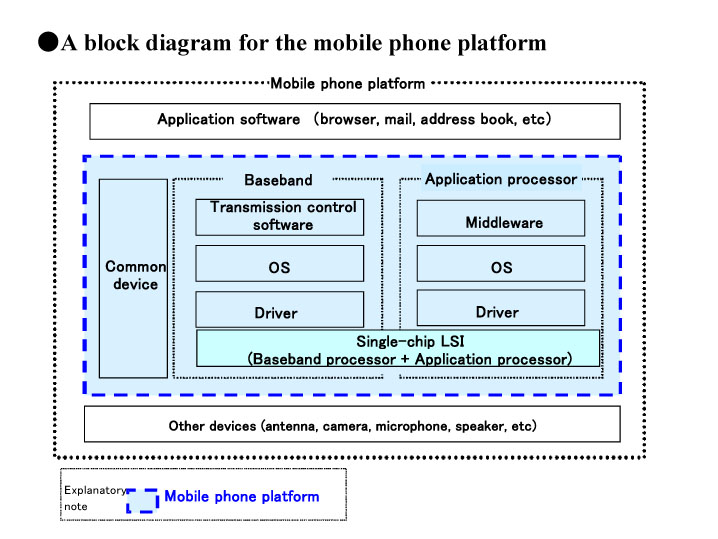
So this is certainly good news for TI. At some point I do need to figure out one discrepancy: everyone has been listing TI as tops in the mobile phone IC market. However, ARM-licensed microprocessors are in more than 80% of all mobile phones being sold (one figure has it above 95%), so who could have more market share than that? So yes, TI is a licensee of ARM and today some of its most popular products are the OMAP application processors containing both a C55x DSP and an ARM9 core.

TI’s own claims are:
  • today the company has the majority of market share in GSM/GPRS mobile devices.
  • Additionally, more than half of 3G WCDMA handsets use TI basebands, and
  • even more use OMAP applications processors.

There’s a double counting problem here: obviously one company could have a majority share for the baseband processor and another majority for the application processor (unless it’s a dual-core processor). There’s even a potential triple counting of share between an IP licensee like ARM, a fabless semiconductor company like Qualcomm and a foundry (like IBM or TSMC used by Qualcomm); it’s only double counting (ARM and TI) for TI which makes its own chips.

Graphic: courtesy Fujitsu.

Technorati Tags: , , ,